
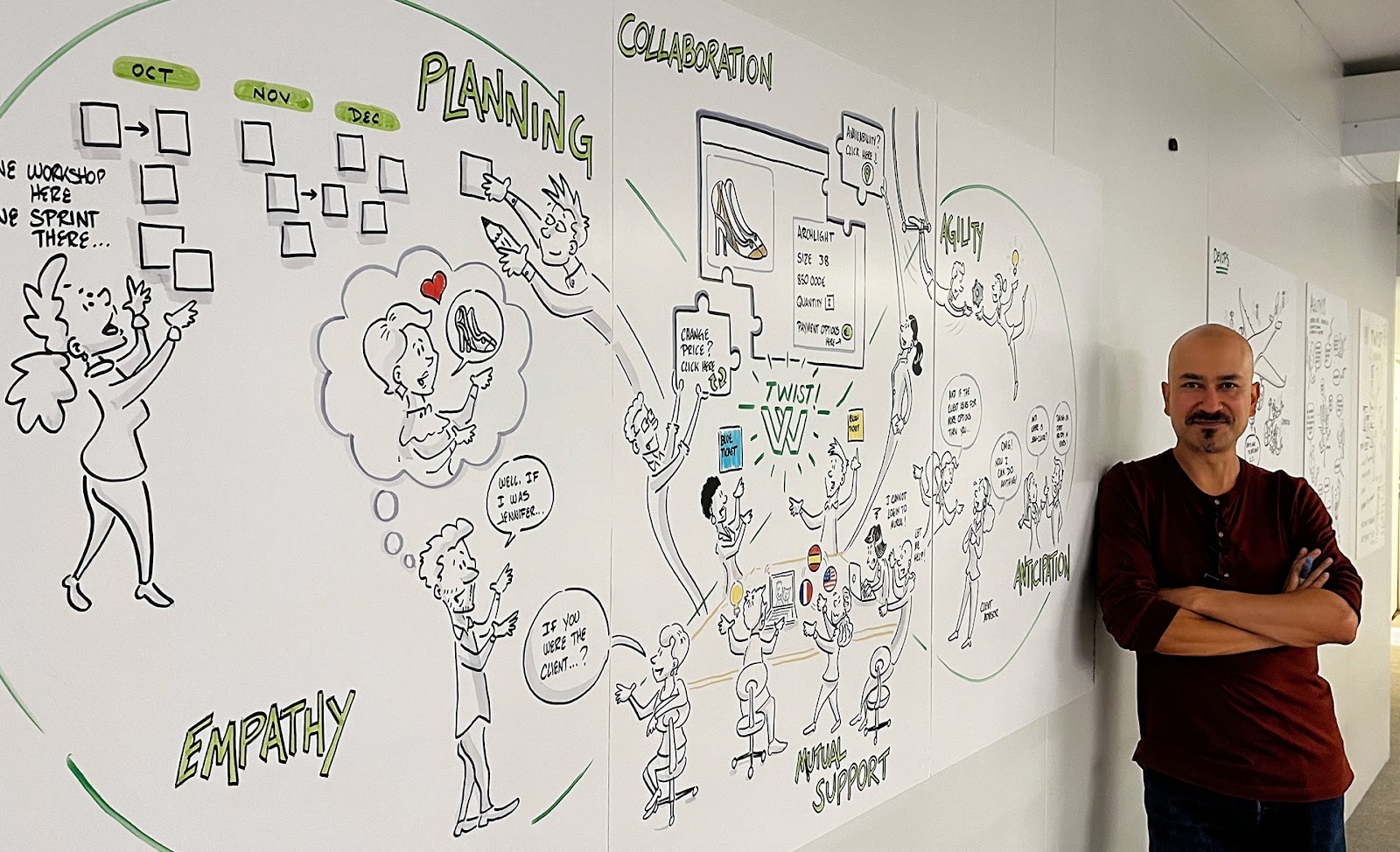
Drawing is widely known to help people remember information better. Many studies have shown that drawing improves how we process details and helps create connections that support memory. When you draw, you’re not only thinking about the idea, but you’re also creating an image and using your hands, which all help you learn and remember more effectively. This works well for individuals—but what happens when you draw for others? That’s where graphic facilitation comes in.
What is graphic facilitation?
Graphic facilitation can have slightly different meanings depending on the context. In this article, we will define it as a way of using drawing to visually show information from a conversation or a process. It uses simple shapes, words, and symbols to present the message clearly.
Graphic facilitation is a helpful way to bring a group’s conversation together. By using simple drawings, it creates a shared base for understanding. People often use different words to talk about the same ideas, but graphic facilitation helps form a common language that everyone can understand. A well-done graphic facilitation piece is easy to understand and often works across different cultures and languages.
How we use graphic facilitation at Plush & Nuggets
At Plush & Nuggets, we’re big fans of graphic facilitation. We use it in several ways.
First, during our workshops, we like to include a graphic facilitator who draws in real-time as participants speak. This creates a special atmosphere as the conversation turns into a visual display. It adds something fun and exciting—we call it the “wahoo effect.”
Second, graphic facilitation is a great way to create clear and easy-to-share visuals that give an overview of what happened during a session. These drawings work both as nice memories and as tools to communicate with others after the workshop.
We also use graphic facilitation to make posters that explain key information in a simple way. These posters are often placed in rooms where they serve both as decoration and as helpful guides.
Finally, even though not everyone on our team is an expert at drawing, we still encourage each other to use drawings to express ideas, explain thoughts, or deliver messages. The drawings may not always be perfect, but the purpose behind them is clear. We believe that combining visual and spoken language helps us communicate more effectively.
So, what’s stopping you? It’s time to give it a try.