
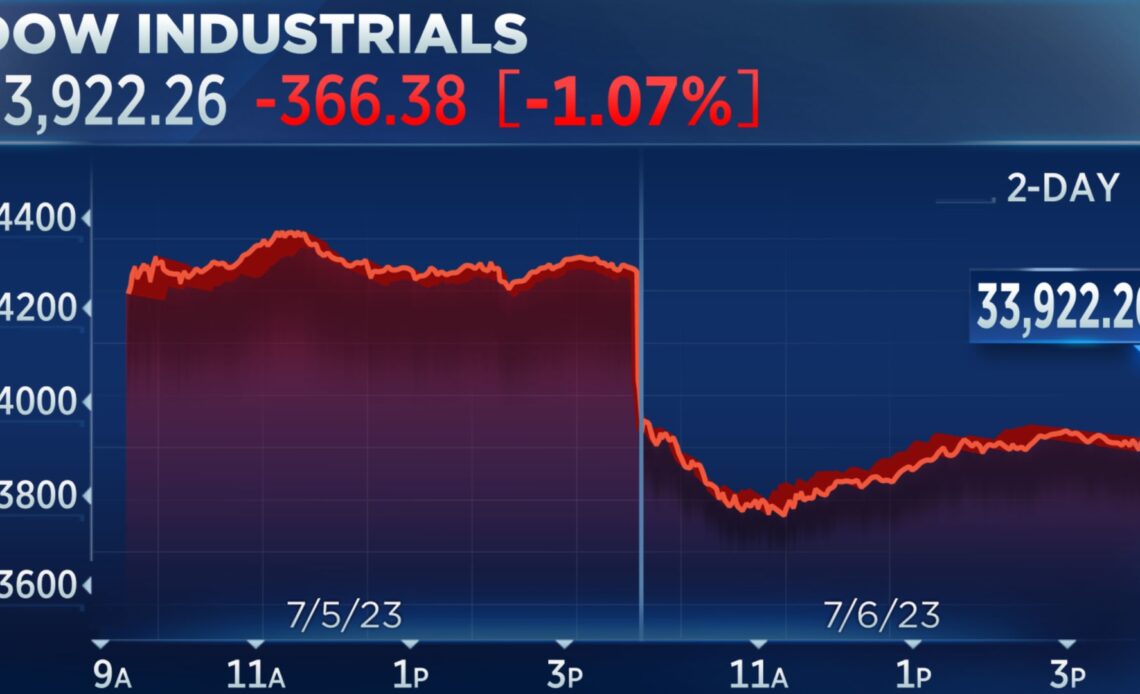
Today, March 19, 2026, the Dow Jones Live is trading around 46,225. The index has faced recent downward pressure, recently hitting its lowest close of the year so far. Market analysts attribute this volatility to geopolitical tensions in the Middle East and concerns over elevated valuations compared to historical cyclically adjusted price-to-earnings (CAPE) ratios.
The Dow Jones Industrial Average (DJIA) is a price-weighted index of 30 large, blue-chip US companies that trades continuously during market hours (9:30 AM – 4:00 PM ET). Live quotes are available across financial platforms in real time during trading hours.
How to Watch the Dow Jones Live
|
Platform |
Access |
Cost |
|---|---|---|
|
Google Finance |
Search “DJIA” |
Free |
|
Yahoo Finance |
finance.yahoo.com |
Free |
|
Bloomberg |
bloomberg.com/markets |
Free (limited) |
|
CNBC |
cnbc.com/dow-jones |
Free |
|
MarketWatch |
marketwatch.com |
Free |
|
TradingView |
tradingview.com |
Free (basic) |
|
Brokerage apps (Fidelity, Schwab, etc.) |
App or web |
Free with account |
Most smartphones also show live Dow Jones quotes in default stock apps or by asking a voice assistant.
The 30 Companies in the Dow
The Dow doesn’t represent the “whole” stock market – it tracks 30 hand-selected blue-chip companies considered representative of the US economy. Current components include:
Apple, Microsoft, Goldman Sachs, UnitedHealth Group, Home Depot, McDonald’s, Visa, Johnson & Johnson, Caterpillar, Boeing, JPMorgan Chase, Walmart, and 18 others.
The Rookie Mistake: Many investors treat the Dow as a proxy for “the market.” It’s not. The S&P 500 (500 companies) and the Nasdaq Composite (all Nasdaq-listed companies) are broader and arguably more representative. A day where the Dow drops 300 points while the S&P barely moves tells you something important about which specific sectors are moving.
How the Dow Is Calculated
The Dow is price-weighted – an unusual methodology that means higher-priced stocks have a bigger influence regardless of company size. A $500 stock moves the Dow more than a $100 stock even if the $100 company is worth more.
Compare this to the S&P 500, which is market-cap weighted (larger companies have more influence). The price-weighting of the Dow is a legacy of its 1896 calculation method that has never been updated.
|
Index |
Companies |
Weighting |
Best Reflects |
|---|---|---|---|
|
Dow Jones |
30 |
Price-weighted |
Blue-chip large caps |
|
S&P 500 |
500 |
Market-cap |
Broad US large caps |
|
Nasdaq Composite |
3,000+ |
Market-cap |
Tech-heavy broad market |
|
Russell 2000 |
2,000 |
Market-cap |
Small-cap US companies |
What Moves the Dow Jones?
On any given day, the Dow moves in response to:
Macroeconomic data:
- Jobs reports (released first Friday of each month)
- Inflation data (CPI and PCE reports)
- GDP growth numbers
- Federal Reserve interest rate decisions
Corporate news:
- Earnings reports from Dow component companies (especially big ones like Apple, Goldman)
- Merger and acquisition announcements
- CEO changes at major companies
Geopolitical events:
- Wars, trade disputes, and sanctions affect global supply chains
- Energy price shocks filter through to transportation and manufacturing components
Market sentiment:
- Fear and greed cycles can move the Dow independently of fundamental data
- The VIX (volatility index) often moves inversely to the Dow
Pre-Market and After-Hours Trading
The Dow’s official calculation runs 9:30 AM – 4:00 PM ET. But Dow futures (contracts betting on where the Dow will open) trade nearly 24 hours on the CME exchange. These futures give an indication of where the market is heading before the official open.
Futures up significantly = positive open expected. Futures down significantly = negative open expected. Neither is guaranteed – major news between the futures signal and the open can change everything.
Bottom Line
The Dow Jones is the most-cited market index in the world, but it’s also one of the narrowest – just 30 stocks, price-weighted in a way that no one would design today. For a real-time pulse on how US blue-chip stocks are doing, it serves its purpose. For understanding the broader market, watch the S&P 500 alongside it. Free live quotes are available everywhere from Google to your brokerage app – no subscription required.